
By Alex Kielar
Originally published in the Breckenridge American
The Breckenridge National Theatre fell silent as dozens gathered for a community screening of “Suicide: The Ripple Effect,” a documentary following suicide-attempt survivor and mental-health advocate Kevin Hines.
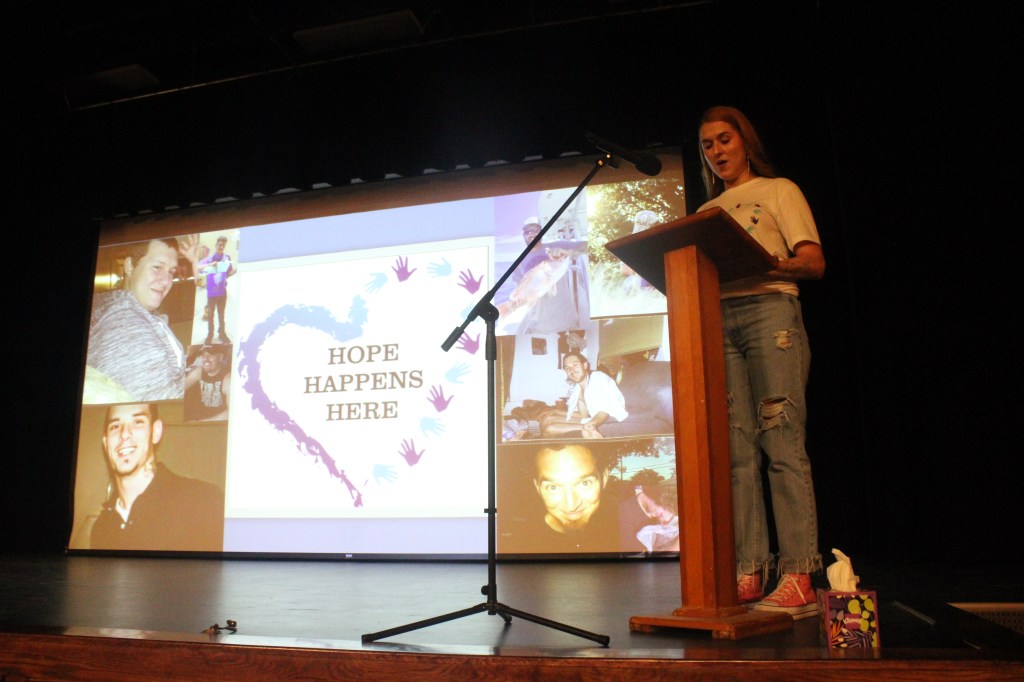
Even before the screening began Saturday evening, Jan. 3, the tone was set by Savanna Morales-Stoker, whose opening remarks framed the night around compassion, honesty and community responsibility.
Morales-Stoker thanked attendees for showing up, not just physically but emotionally and mentally as well. She acknowledged that many in the room might be struggling themselves, and that their presence demonstrated empathy and a willingness to support others.
“Whatever you are feeling is valid,” she told the young people in the audience, emphasizing that emotions like stress, sadness, anxiety and anger “do not mean you are weak or broken.”
She urged them to reach out to trusted adults and reminded them that asking for help was a sign of strength.
Morales-Stoker also addressed a group too often overlooked in mental-health conversations—men. Citing statistics showing Stephens County’s suicide rate at 33% above the national average, she spoke about how cultural expectations often push men into silence.
“Men deserve space to speak, to feel and to be supported without judgement,” she said.
As community members filed into the theater before the film began, volunteers handed out small baggies containing a prayer card, a pen and an informational resource card. Anyone struggling but not ready to speak up that night were invited to write down their contact information and leave it discreetly at the door so someone could follow up later.
The resource card included a QR code linking to a confidential website where individuals could chat with a licensed professional privately from their phone—a tool created by the Arturo’s Hart Foundation, a non-profit organization founded by Yuri Huntington and her sister, Tanya Emerson, after the loss of Emerson’s son, Arturo, three years ago.
To find out more about the foundation, please visit https://yurihuntington.com/ahf or go to the Arturo’s Hart Foundation Facebook page.
Huntington, former Executive Director of the Breckenridge Chamber of Commerce and a licensed brain-health trainer, explained the foundation’s mission to alleviate the suffering of those affected by suicide by providing education rooted in understanding the brain as an organ.
“All of these services we provide are free,” Huntington said as she outlined three core programs that are in the developmental pipeline.
The first program is coaching labs which provide people with lessons in understanding more about how suicide effects and shows up in the brain. The second program is Heart Leaders training for individuals who want to learn how to offer hope, advocacy, resilience and transformation to people struggling. The third program is peace retreats for grieving families to attend in order to help start the healing process.
“All of these services are coming in the future as we raise the funds,” Huntington said.
She also announced an upcoming program called Amen Whole-4, which focused on four areas of healing—spiritual, biological, psychological and social. This program, she said, would launch in Breckenridge within the next couple of months, either late February or early March.
Testimonies from those healing
After the documentary, Morales-Stocker returned to the front of the room to share her own story before passing it off to other community members who have lost loved ones to suicide. She spoke about her father, Michael, who died in 2004, 7,825 days before the documentary screening—a number she said marks how long her life has been shaped by his absence.
“He never got to watch me graduate. He wasn’t there to walk me down the aisle. He never got to meet his grandchildren,” she said.
Now raising three boys, she said her mission was to ensure her children grow up knowing their emotions matter and that they will never have to struggle alone.
Becky, the grandmother of Joshua Gutierrez, described her grandson as a bright, kind presence whose loss in November left “a void that can never be filled.” She reflected on the pain carried by Joshua’s parents and brothers, and the strength they’ve shown in honoring his memory.
“We must always be there for our loved ones—to listen, to understand and to offer help when it’s needed,” she said.
Chasity Wiloth spoke next, reflecting on the 16 years since losing her brother. She remembered him as full of life, but also struggling in ways that were harder to see at the time.
“They say time heals the pain, but that’s not true,” she said. “We miss him a lot.”
Wiloth’s message to the audience was simple: reach out, ask questions and check on the people around you.
For Huntington, the loss of her nephew reshaped both her ministry and her mission. As a traveling minister who had long counseled others through grief, she described the challenge of continuing to serve while navigating her own heartbreak.
She and her sister committed to transforming their pain into purpose, advocating for brain-health awareness and reducing stigma. She pointed to Breckenridge’s suicide rate and the sharp rise in adolescent suicides nationwide as evidence that change was urgently needed.
Several testimonies were also read aloud on behalf of community members not speaking themselves.
One came from a widow raising two young children after the loss of her husband, Rex. Another came from the fiancee of Zach, who described her life as divided into “a before, and an after” she never asked for, and spoke of raising his son with honesty, gentleness and resilience.
Emily, who lost her best friend Brock, wrote about the guilt and grief she carried, and the commitment she now feels to advocate for men’s mental health.
“No one is weak for feeling emotions,” she wrote. “Let me help you carry the pain while you heal.”
The final testimony came from the sister of Eric Thomas, a Marine remembered for his loyalty, humor and fierce love for his family. Her words described a grief that “splits your life in half,” but also a renewed commitment to kindness, connection and speaking openly about mental health.
The evening closed with a message of hope and a reminder that mental health is a shared responsibility.
“Strength is not silence,” Patrick Frishe, pastor at Gunsight Baptist Church, said. “Strength is connection.”
A prayer followed, emphasizing that no one in the community should have to fight their battles alone. Frishe asked the room to repeat a simple phrase,“I am loved”—a reminder, he said, that too many people never hear those words when they need them most.
“Are you okay?” He asked the audience to carry that question into their daily lives. “Sometimes that’s all someone needs.”
As attendees filtered out of the theater, many lingered—hugging, talking and checking in on one another.
The ripple effect of the night was exactly what organizers hoped for—a community choosing compassion, connection and conversation.

 My Creative Portfolio
Leave a comment